
The EU-funded ReHydro project has developed a methodology to assess the multiple water uses around hydropower sites, from electricity generation and flood management to recreation and ecosystem support. By examining the conditions these uses depend on, the methodology aims to help owners, developers and other stakeholders understand where their requirements align and where tensions may arise, providing a clear basis for discussing water management.
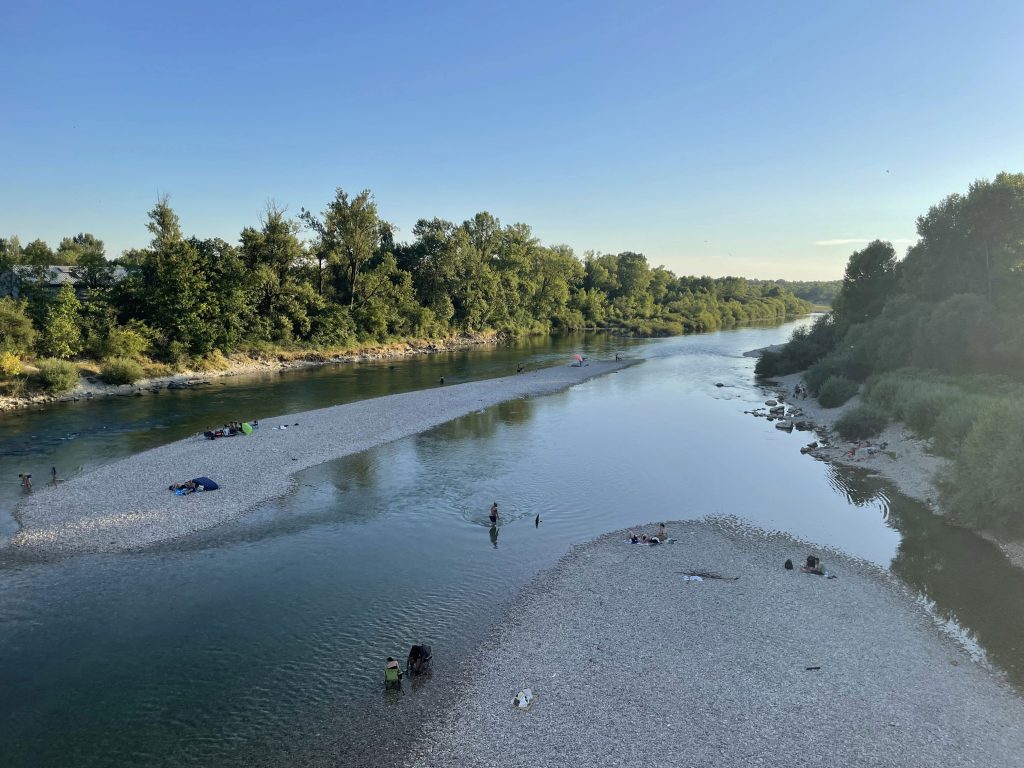
From May to September, water uses overlap in the Ain Valley during the catchment’s low-water period. Irrigation, bathing, and other recreational activities coincide with continuing needs for electricity, drinking water, and aquatic ecosystems. Understanding these needs means considering both the water available and the optimal conditions for each use.
Using the Vouglans Saut Mortier (VSM) hydropower project as its case study, ReHydro developed a methodology to examine how multiple water uses and hydropower operations interact with each other, and how it further influences the ecosystem in rivers and reservoirs.
Located in the middle Ain Valley, VSM forms part of a connected cascade of reservoirs and power stations. Storing and releasing water influences conditions within the reservoirs and in downstream river reaches, where other activities and ecosystems depend on it. The methodology therefore looks at the wider river system and considers the multiple water uses to provide a structured way for plant owners, operators, local authorities and stakeholders to analyse which of these uses may be constrained, where, and during which periods (ReHydro, 2025).
Sharing water requires understanding of different needs
Reservoirs and rivers can support many of the same activities, including fishing, bathing and kayaking. However, a shared activity does not necessarily have the same requirements everywhere. For example, recreational activities can have significantly different needs depending on the activity: kayaking on a reservoir generally benefits from calmer water and suitable launching access, while white-water kayaking depends on sufficient depth and current velocity, so therefore generally takes place on a river. Thus, identifying a water use is only the beginning: it is important to specify where and how it is practised.
Aquatic organisms depend on suitable temperatures, oxygen levels and habitats. Those who wish to recreate require access which can be affected by changing reservoir levels and the shape of the banks. Farmers who rely on reservoirs and rivers for irrigation depend on water being available when crops need it.
Climate change adds pressure to the management of these overlapping uses. The European Environment Agency reports that water scarcity affected 28% of EU territory during at least one season in 2023. Across Europe, reduced flows can combine to intensify spring and summer pressures as climate change intensifies seasonal fluctuations in freshwater availability (EEA, 2025). Indicating an increased concentration of periods in which the water is becoming scarcer, yet the needs for the water remain the same. When less water is available, meeting different water-use requirements can become more difficult. Applying ReHydro’s matrix to scenarios that account for climate change could help identify potential constraints in advance, giving operators and other stakeholders an opportunity to discuss responses.
Bringing different requirements together
To bring water uses and their requirements into one view, ReHydro’s methodology produces a matrix. It links each use to measurable parameters of the water system, such as temperature, dissolved oxygen concentration, and bank slope. Then, for each parameter, thresholds are defined and then rated as one of four options for that specific use: incompatible, limited, compatible or optimal.
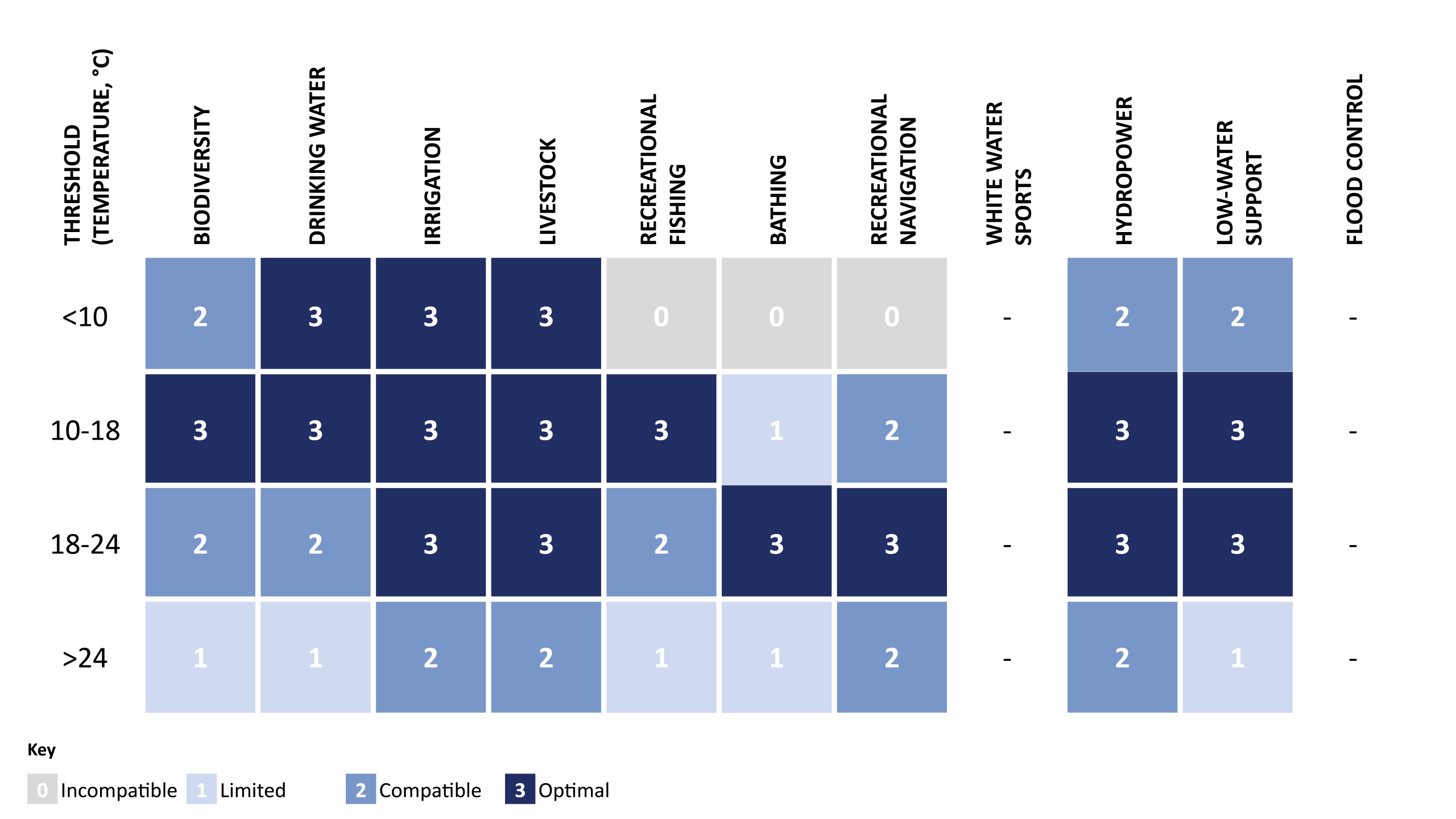
Table 1. Detail of the water use matrix for the parameter “temperature” in the Ain valley system.
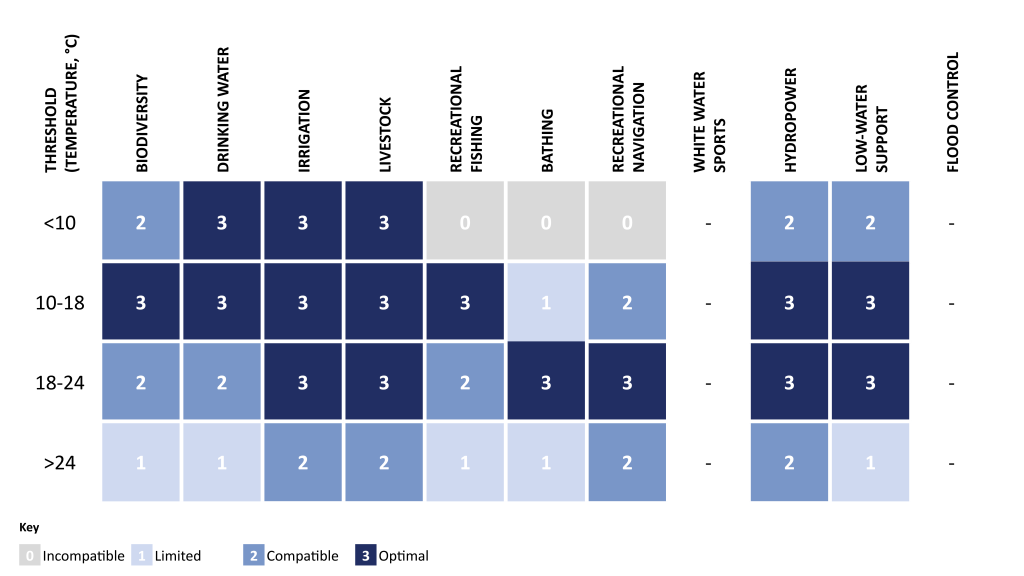
Let’s illustrate this with one example, the temperature parameter which has four different thresholds: <10°C, 10-18°C, 18-24°C, and >24°C. In the proposed matrix, see Table 1, the 10-18°C band is rated optimal for both biodiversity and recreational fishing but rated limited for bathing. This is because that temperature range suits the conditions in which local organisms thrive in the Ain Valley, but the water is too cold for the average user to enjoy a swim. Alternatively, at 18-24°C, average users enjoy bathing and thus it is rated optimal, while this temperature range is not the best for biodiversity, or fish, but it is still acceptable. Thus, these activities are rated compatible. The same temperature therefore receives different ratings according to the use being considered. For further examples, the reader is referred to the full matrix displayed in the ReHydro deliverable (ReHydro, 2025).
The proposed thresholds draw on scientific and regulatory documents, operational experience and local information, predominantly from France. The methodology can guide work at other sites, but the water uses included, and the thresholds applied, need to reflect local activities, ecosystems, and rules.
Applying the matrix at Vouglans Saut Mortier
The proposed matrix can be used to examine both current and future conditions. At VSM, ReHydro is currently modelling the river system, including considering future climate scenarios. When this is ready, the modelled physical conditions such as water level, temperature, and oxygen level will be inputted in the matrix. Then, the matrix will help identify when and where conditions may constrain some water uses, giving operators, authorities, and affected stakeholders a basis for discussing potential actions before those conditions arise.
ReHydro’s research team is also developing a spreadsheet to make the matrix easier to apply to other hydropower systems. Users would still need to identify relevant local uses, obtain site data and check the thresholds against local conditions. The spreadsheet could nevertheless reduce the preparatory work needed to examine those uses together, providing a clearer starting point for discussions about water management.
More information regarding the Matrix development can be found in the full deliverable.
References:
EEA, 2025. Water scarcity conditions in Europe [WWW Document]. URL https://www.eea.europa.eu/en/analysis/indicators/use-of-freshwater-resources-in-europe-1 (accessed 10.6.26).
ReHydro, 2025. D5.2 Matrix of future water use.